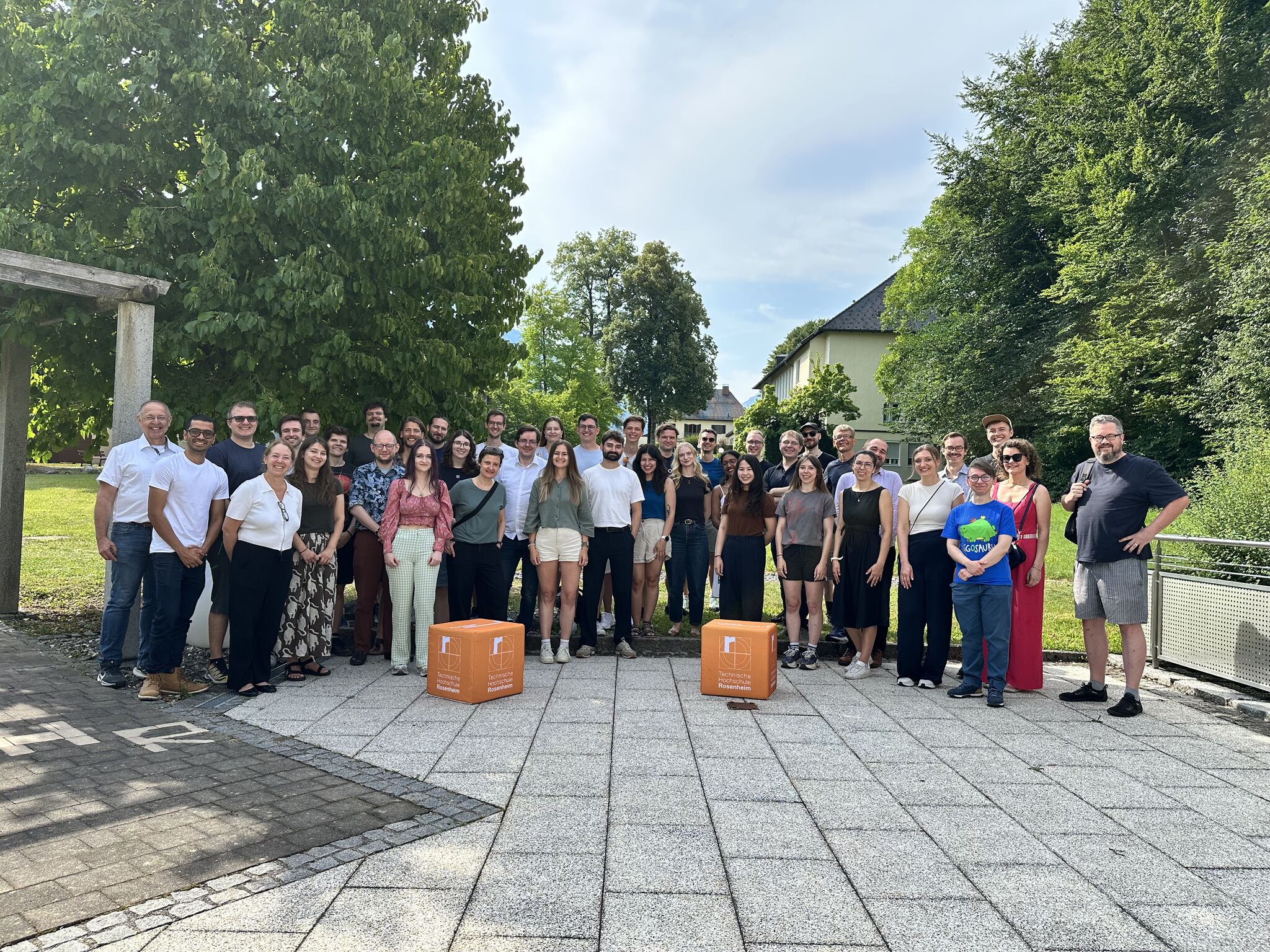
Last week, we wrapped up the Beyond Vibe Coding: A Systematic Approach to Creating Digital and Physical Artifacts with Generative AI summer school at TH Rosenheim Campus Chiemgau in Ruhpolding. Over four intensive days, students and researchers explored how generative AI can support the creation of both digital and physical artifacts, moving beyond ad-hoc prompting toward a systematic workflow built around clear specifications, iterative development, and fabrication.
The summer school combined lectures with hands-on tutorials and collaborative project work. Rather than treating AI as a magic box, the focus was on understanding how to integrate it into every stage of the design process. From websites and virtual environments to laser-cut objects, 3D prints, and CNC-milled products, the goal was to explore how AI can become a reliable design partner rather than simply a code generator.
Starting with the Manufacturing Process
Our design process was somewhat counterintuitive; the available fabrication technologies were incorporated into the ideation process. Since the summer school gave us access to a CNC milling machine, something none of us normally have available in our own labs, we deliberately worked backward. Rather than asking “What should we build?”, we asked, “What product could truly benefit from this opportunity?”
Surrounded by the mountains around Ruhpolding, with countless hiking, trail running, and mountain biking routes nearby, the direction quickly became obvious. Building on our previous HCI research on data physicalization and situated artifacts, we began exploring how meaningful outdoor experiences could become lasting physical artifacts rather than being forgotten GPX files on a smartwatch or activity platform.
This idea is naturally connected to our previous work on Situated Artifacts. In our DIS 2025 paper, Situated Artifacts Amplify Engagement in Physical Activity, we showed that physical representations of activity data create a stronger presence in everyday life and foster greater engagement than comparable digital artifacts. While that work focused on encouraging future physical activity, Contour extends the idea toward preserving meaningful experiences as tangible memory objects. If you’re interested, you can read the paper https://doi.org/10.1145/3715336.3735690.
From Research to Product
Over just four days, we developed Contour, a concept that transforms hiking adventures into CNC-milled wooden terrain models generated from GPS tracks and topographic data. Instead of displaying a hike on a screen, the experience becomes a handcrafted object that can remain in your home long after the adventure ends.
One idea that particularly resonated with our team emerged only after many iterations. Rather than simply choosing a wood species, why not allow hikers to send us a meaningful piece of wood collected during their journey? Every artifact could then preserve not only the digital trace of the hike but also a tangible piece of the experience itself.
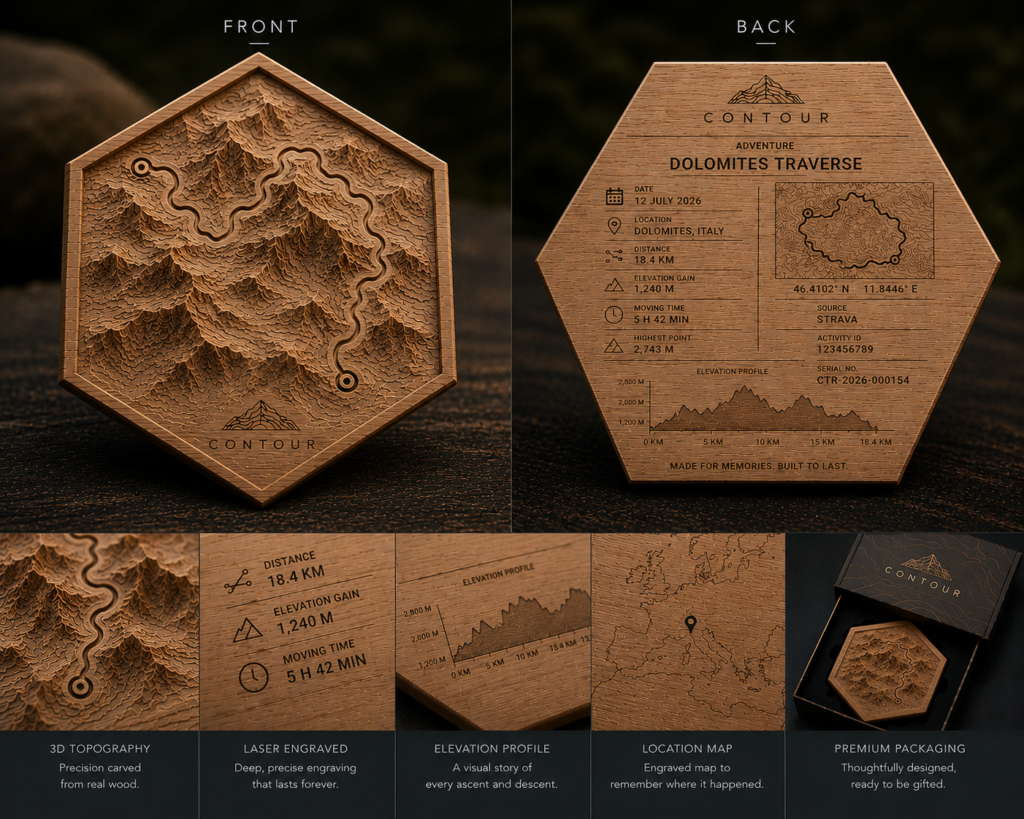
While the final concept looks polished, getting there involved far more than asking an LLM to “design a product.” We iterated through countless versions of the website, product renders, manufacturing pipeline, branding, copywriting, and CAD models. Every iteration brought us a little closer to something that felt both desirable and technically feasible.
See the full product page at https://sven-mayer.com/contour
Finally, a huge thank you to everyone who contributed ideas, discussions, and feedback throughout the week. Contour was truly a team effort, and I feel incredibly fortunate to have worked alongside such a talented and inspiring group of people. Special thanks to Thomas Weber, Philipp Thalhammer, Maximiliane Windl, Anna Walczak, and Julia Dominiak for making this such a fun and rewarding collaboration.
Beyond Vibe Coding
One observation stayed with me throughout the week. Generative AI makes it remarkably easy to create a convincing first draft. Within minutes, you can have a website, a product render, marketing copy, or even a CAD model that looks surprisingly good. Reaching that first 80% has never been easier. The remaining 20%, however, tells a very different story.
Getting AI to produce exactly what you envision, ensuring outputs are technically correct, manufacturable, and refined to every detail, still requires patience, domain expertise, careful evaluation, and many iterations. In our case, one of the biggest remaining challenges became generating reliable CNC toolpaths and G-code. While LLMs can produce plausible G-code, creating robust machining instructions that consistently manufacture the intended geometry is a much harder problem.
In many ways, this perfectly reflects the summer school’s title. Going beyond vibe coding is not about replacing engineering or design with AI. It is about combining AI with systematic thinking, clear specifications, validation, and collaboration. AI dramatically accelerated exploration, allowing us to evaluate far more ideas than we normally could. But the final quality still depended on discussions, critical thinking, and domain expertise.
For me, this was perhaps the biggest takeaway from the week: AI is no longer the bottleneck for creating ideas. The real challenge lies in deciding which ideas are worth pursuing and guiding AI until it produces exactly the result you need.
Looking Ahead
Contour certainly does not end with the summer school. We are planning to continue developing the concept, particularly the manufacturing pipeline and the generation of reliable CNC toolpaths. I could also imagine this becoming an exciting future student project that further bridges HCI research, generative AI, and digital fabrication.
Special thanks also go to Sebastian Feger, Ina Fuchshuber, and Albrecht Schmidt for carrying the load and organizing such an outstanding summer school. They created an environment that perfectly balanced inspiring talks, hands-on experimentation, and collaborative project work.
Looking back, what impresses me most is not that we developed a product concept in four days. It is that we started with an HCI research idea and, through collaborative discussions, systematic use of generative AI, and rapid iteration, transformed it into something that feels technically feasible, meaningful, and genuinely exciting to continue exploring.